
How to Write Christian Lyrics: Build a Verse and Chorus That Connect
November 4, 2026
Christian Songwriting Sessions — Part 2 of 4
A page full of meaningful thoughts can still feel a long way from a song.
Which line comes first? What belongs in the chorus? And does everything have to rhyme?
In Part 1, you chose a message and working title. Now we will give those ideas a shape your listener can follow. If you are joining us here, begin by writing one sentence about what you want your song to say.
Give your verse and chorus different jobs
Think of the verse as the place where the experience unfolds. The chorus carries the central truth or response you want people to remember.
For our practice song, “One Step With You,” the verse can describe uncertainty. The chorus can become a prayer of trust.
Here is an original draft verse:
The kitchen clock says half past two,
An open Bible fills my view.
I read the lines, then read once more,
And leave my questions at Your door.
The verse gives us a setting and an action. The chorus can now express what that moment means:
One step with You, then one step more,
I bring the fears I held before.
I cannot see the whole way through,
But I can take one step with You.
These are starting lines, ready for revision as a melody develops. Notice how the title returns at the end of the chorus. Repetition gives the listener something familiar to hold onto.
Start with a structure you can finish
Try this arrangement:
Verse 1 → Chorus → Verse 2 → Chorus → Bridge → Final Chorus
You can add an instrumental introduction and ending later.
Verse 2 should move the thought forward. If Verse 1 introduces the struggle, Verse 2 might show a response: reaching for help, remembering God’s faithfulness, or taking a small action in trust.
A bridge offers a fresh perspective or a musical lift before the final chorus. It is optional. If your song says what it needs to say without one, let it stand.
Use rhyme without letting it choose your message
Two useful patterns are AABB and ABAB. In AABB, the first two lines rhyme with each other, followed by another rhyming pair. In ABAB, the first and third lines rhyme, and the second and fourth lines rhyme.
Perfect rhymes are useful, but near rhymes can also work when sung naturally.
The real test is whether the line says something you mean. If a rhyme forces an awkward word or an unclear claim about God, rewrite it. Meaning comes first.
Read your lyrics aloud as ordinary speech. Would you say that sentence to someone? If it sounds forced, simplify it.
Make repeated sections feel related
Verses commonly share a melody while using different words. Keep their line lengths and natural stresses reasonably similar so both verses can fit the same tune.
Count syllables if it helps, but listen for emphasis, too. A line can have the right number of syllables and still feel uncomfortable if the music stresses the wrong word.
Your chorus should be easy to recognize each time it returns. Repeating its core wording helps listeners learn it.
Your second songwriting assignment
Write one verse and one chorus using your Part 1 notes. Read them aloud, then remove any line that repeats an idea without adding anything useful.
Finally, underline your strongest chorus line. That is the line we will focus on when creating a melody.
Coming in Part 3: You have words—but how do you find a tune? We will explore melody and simple chords, including a starting point for writers who do not play an instrument.
For Christian Songwriters
Join the Songwriting List
- ✦The best songwriting guidance — lessons from message to finished demo
- ✦Software and hardware recommendations for recording your songs
- ✦AI tools that can help you brainstorm, arrange and produce
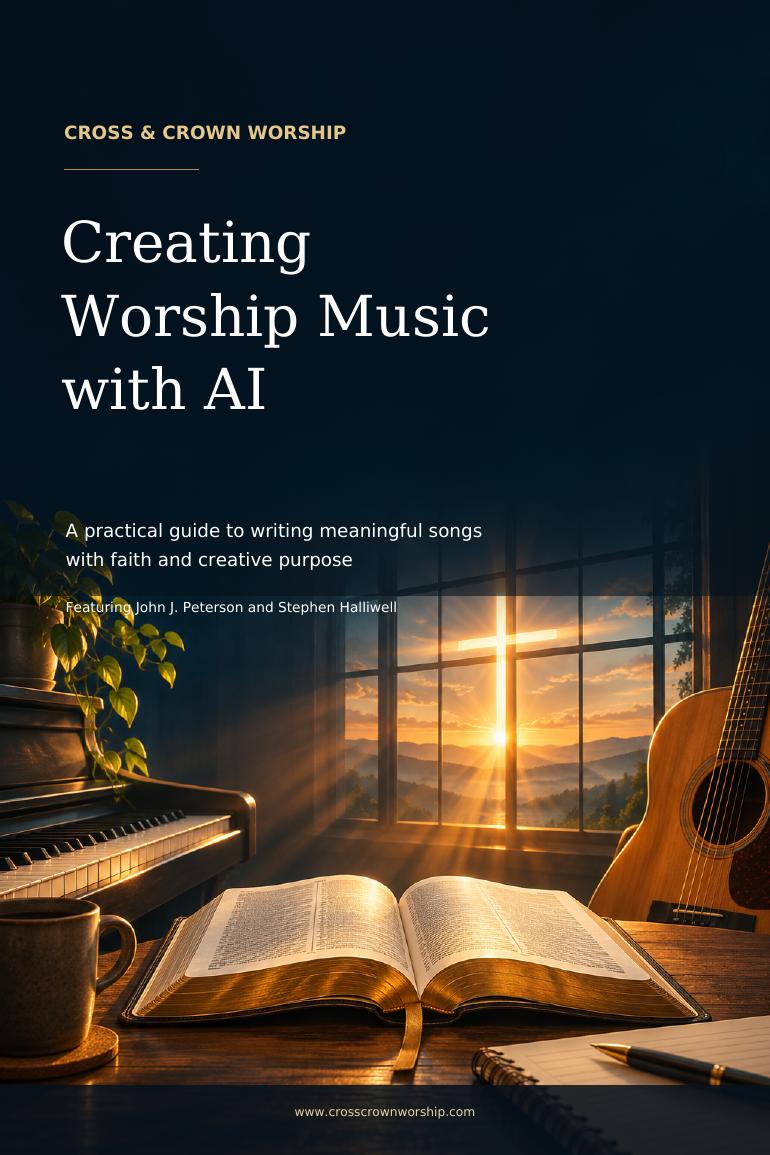
New Ebook · PDF Download
Creating Worship Music with AI
A practical 20-page guide for Christian songwriters by John J. Peterson and Stephen Halliwell — shape a biblical theme, write and revise lyrics, direct an arrangement with AI tools like Suno, and plan your release.