
How to Find a Melody for Your Christian Song—Even Without an Instrument
November 5, 2026
Christian Songwriting Sessions — Part 3 of 4
You read your chorus again. The words mean something to you. Now comes the question: what should they sound like?
Finding a melody often begins with experimenting aloud. You can start with your voice and a recording device, even if you cannot play piano or guitar.
In Part 2, you wrote a verse and chorus. Today, we will turn one of those lines into a musical starting point.
Speak your strongest line first
Take the chorus line you underlined and say it naturally several times. Notice which words receive emphasis and where you pause.
For “But I can take one step with You,” you might naturally emphasize “take,” “step,” and “You.” Those stresses can suggest a rhythm.
Now sing the line three different ways. Try one that rises toward the end, one that settles downward, and one that repeats a small group of notes.
Record all three. Give each recording a clear name so you can find it later. You are collecting possibilities; you do not need to decide immediately.
Create contrast between verse and chorus
A verse might use a quieter delivery and a narrower range of notes. The chorus might open into longer notes or a slightly higher melody.
Those are options, not requirements. A restrained chorus can be powerful, too.
The important question is whether the musical change helps the message arrive. Sing the verse directly into the chorus and listen for a clear transition.
If you hope a congregation will sing the song, try it with other singers. A tune that suits your voice alone may need adjustment for a group.
Try a simple chord progression
A chord progression is a sequence of chords. You can repeat a short progression while experimenting with different melodies.
Here are three starting points in C major:
I–V–vi–IV (C–G–Am–F): Hold each chord while singing your chorus.
I–vi–IV–V (C–Am–F–G): Listen to how the return to C feels.
vi–IV–I–V (Am–F–C–G): Try the same lyric over a different opening chord.
Uppercase Roman numerals identify major chords here; lowercase numerals identify minor chords. In a major key, the basic diatonic triads follow I, ii, iii, IV, V, vi, and vii°.
For an easy exercise in 4/4 time, hold each chord for four beats. One measure contains four beats in this time signature; four measures contain sixteen beats. Other time signatures organize beats differently.
You can use the same chords in your verse and chorus. Melody, rhythm, and delivery can supply the contrast.
If you do not play an instrument
Record your unaccompanied melody first. Then ask a musician or co-writer to help find supporting chords. You can also experiment with a virtual keyboard or chord-playing software.
Treat pitch and key estimates as clues. A single sung note does not establish the key of an entire song, and matching a melody note to a chord name does not automatically identify the best harmony.
Listen to the full phrase over several chord choices. If you feel stuck, bring your recording to someone who can help. Collaboration is a normal part of songwriting.
Your third songwriting assignment
Record three versions of your chorus melody. Choose the one that feels most natural, then sing the entire verse and chorus together.
Listen again the next day. Can you remember the chorus without replaying it? Which words feel rushed? Make one useful revision.
Coming in Part 4: We will turn your developing song into a simple demo and identify the feedback that actually helps you finish.
For Christian Songwriters
Join the Songwriting List
- ✦The best songwriting guidance — lessons from message to finished demo
- ✦Software and hardware recommendations for recording your songs
- ✦AI tools that can help you brainstorm, arrange and produce
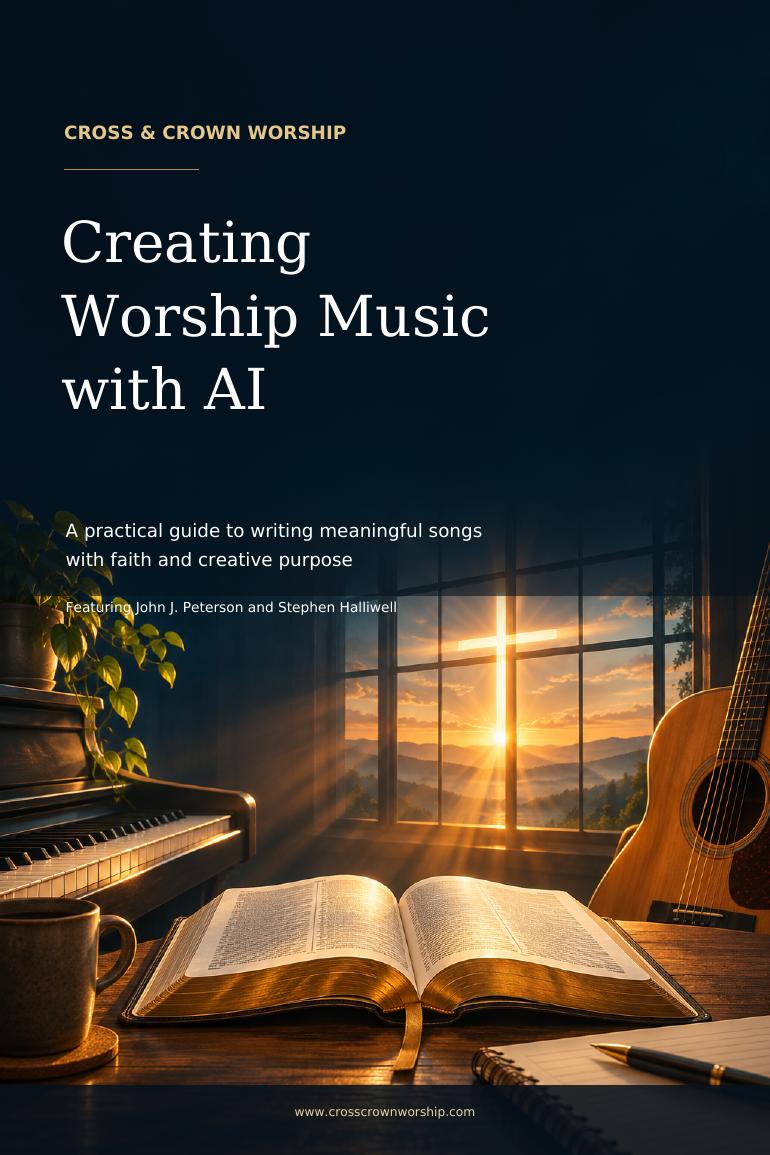
New Ebook · PDF Download
Creating Worship Music with AI
A practical 20-page guide for Christian songwriters by John J. Peterson and Stephen Halliwell — shape a biblical theme, write and revise lyrics, direct an arrangement with AI tools like Suno, and plan your release.